
Solar EV Charging at Home: Charging Your Electric Vehicle With 100% Free Sunshine
Smart solar EV chargers divert excess rooftop photovoltaic generation directly into your car battery, achieving truly zero-emission motoring and zero fueling costs.
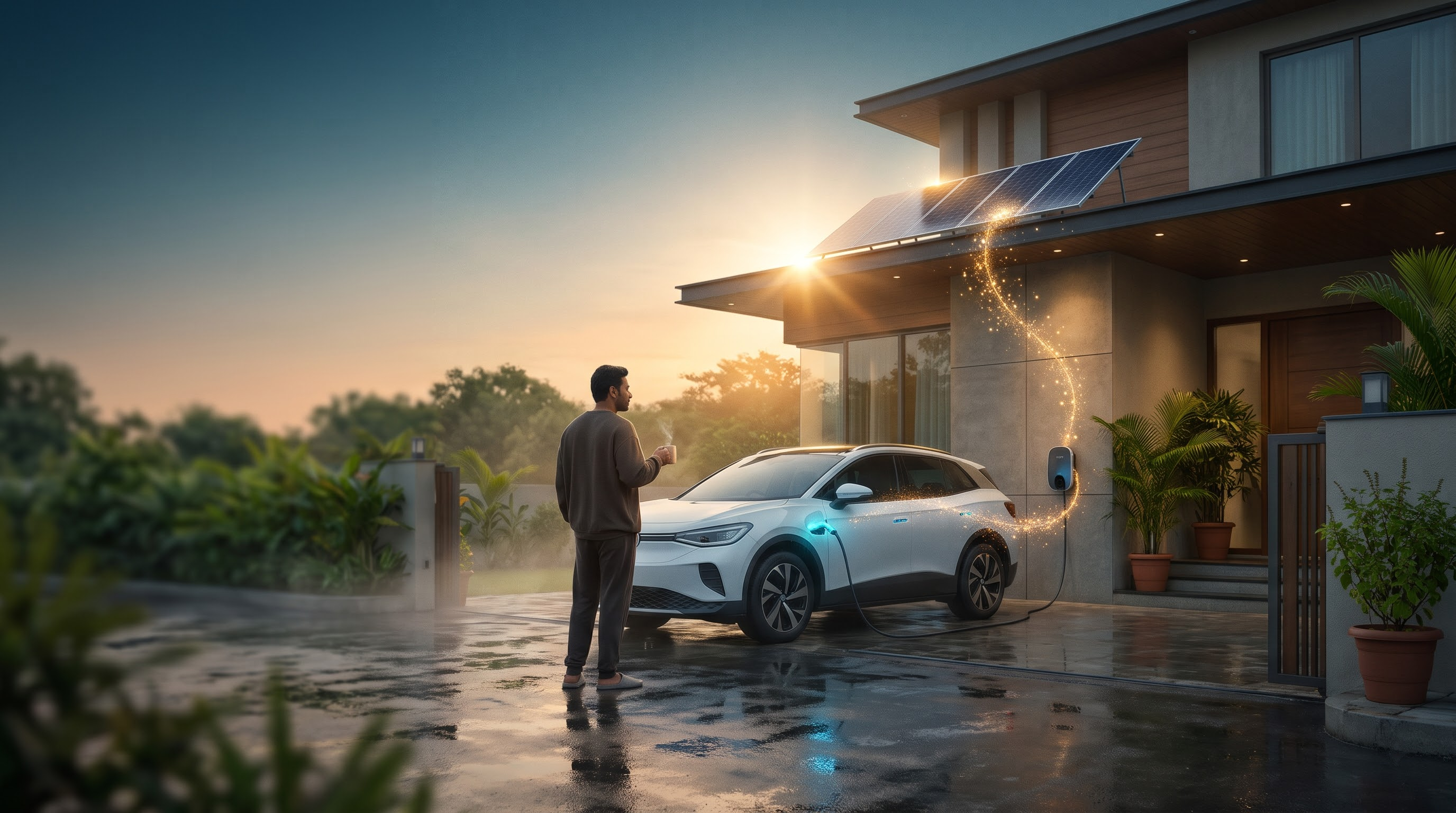
Smart solar EV chargers divert excess rooftop photovoltaic generation directly into your car battery, achieving truly zero-emission motoring and zero fueling costs.
Driving an electric car charged from coal-heavy grid electricity reduces tailpipe emissions, but driving an EV charged from your own solar rooftop delivers genuine zero-carbon mobility and virtually free transportation.
Traditional EV chargers draw maximum amperage from the panel regardless of whether your solar system is producing or your home is consuming. Smart solar EV chargers (such as 7.4kW single-phase or 22kW three-phase units) utilize CT clamp sensors at the main distribution board to measure real-time solar export.
When solar export is detected, the charger modulates its current output to match solar surplus exactly (solar-only eco mode). If a cloud passes over, charging slows; when the sun blazes, charging surges to capacity without pulling a single watt from the utility grid.
Driving 1,500 km per month on solar power costs less than $35 in amortized hardware compared to $280+ in petrol, yielding annual transportation savings upwards of $2,900.
Ready to evaluate your solar feasibility?
Use our rooftop solar calculator to estimate system size, subsidy eligibility, and lifetime electricity savings in 60 seconds.
Related Clean Energy Insights
Browse all →
2026 Australian Solar Rebate Guide: How to Claim Up to $3,500+ in Federal STCs & State Loans
Step-by-step breakdown of Australia’s Small-scale Renewable Energy Scheme (SRES) and STCs. Learn DNSP grid connection timelines, point-of-sale discounts, and exact rebate math from 6.6kW to 15kW systems.
Liam Davies
Head of Regulatory Affairs & Grid Compliance

N-Type TOPCon vs. Mono PERC: Which Solar Technology Wins in High Ambient Heat?
Comparing temperature coefficients, bifacial gain, LID degradation, and lifetime LCOE between N-Type Tunnel Oxide Passivated Contact (TOPCon) and P-Type Mono PERC panels.
Dr. Aris Thorne
Principal Photovoltaic Research Engineer

LiFePO4 Home Battery Storage: Zero Degradation Backup & Peak Shaving Explained
Why Lithium Iron Phosphate (LiFePO4) chemistry has made lead-acid and NMC obsolete for domestic solar battery backup. Safety, 6,000-cycle longevity, and time-of-use arbitrage.
Elena Rostova
Lead Energy Storage Systems Architect